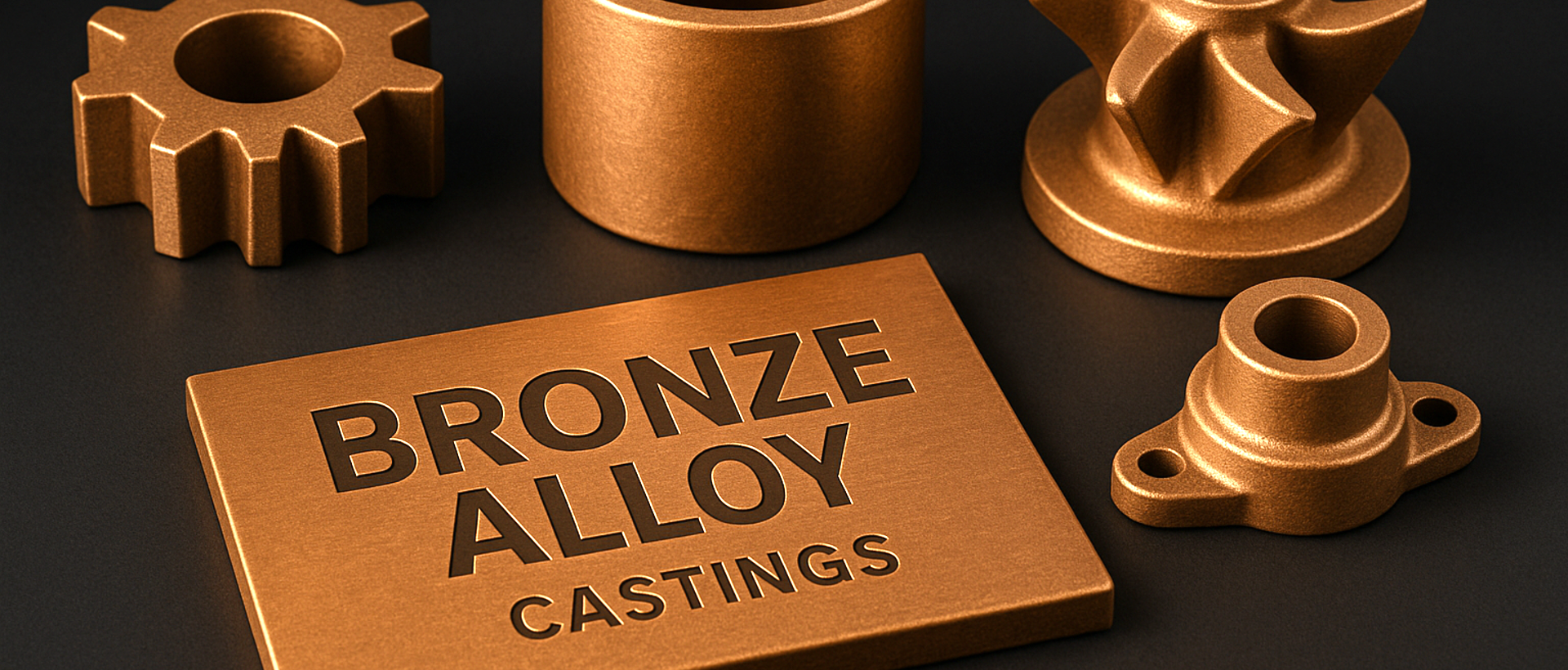
Bronze Alloy Castings are widely used across engineering, marine, aerospace, structural, and industrial sectors due to their superior mechanical strength, excellent corrosion resistance, wear resistance, and versatility. Bronze casting alloys include Gunmetal Bronze, Phosphor Bronze, Aluminium Bronze, Silicon Bronze, and their variations — each optimized for specific performance requirements.
Casting Capabilities
Bronze castings can be produced according to customer drawings and international standards.
| Specification | Capability |
|---|---|
| Weight Range | 0.5 kg – 2,000 kg per casting |
| Casting Processes | Sand Casting, Centrifugal Casting, Investment Casting |
| Dimensional Tolerance | As per ASTM / BS / ISO / customer specs |
| Finishing Options | As-cast, CNC machined, polished, shot-blasted |
Key Features
- Excellent corrosion resistance, especially in seawater and industrial atmospheres.
- High tensile strength and fatigue resistance for heavy-duty applications.
- Superior wear, galling, and abrasion resistance.
- Good machinability and polishability.
- Exceptional casting properties and dimensional accuracy.
- Low friction characteristics, suitable for bearings and sliding components.
- Good thermal and electrical conductivity (varies by alloy type).
- Long service life even under high-load and high-temperature conditions.
Applications
- Pump bodies, valve housings and high-pressure components.
- Propellers, marine fittings, seawater-contact parts.
- Industrial bearings, bushings & wear-resistant parts.
- Gears, worm wheels & mechanical power transmission parts.
- Architectural castings, sculptures & decorative elements.
- Mining, oilfield & heavy machinery components.
- Electrical fittings, connectors & grounding parts.
- Hydraulic and pneumatic system components.